

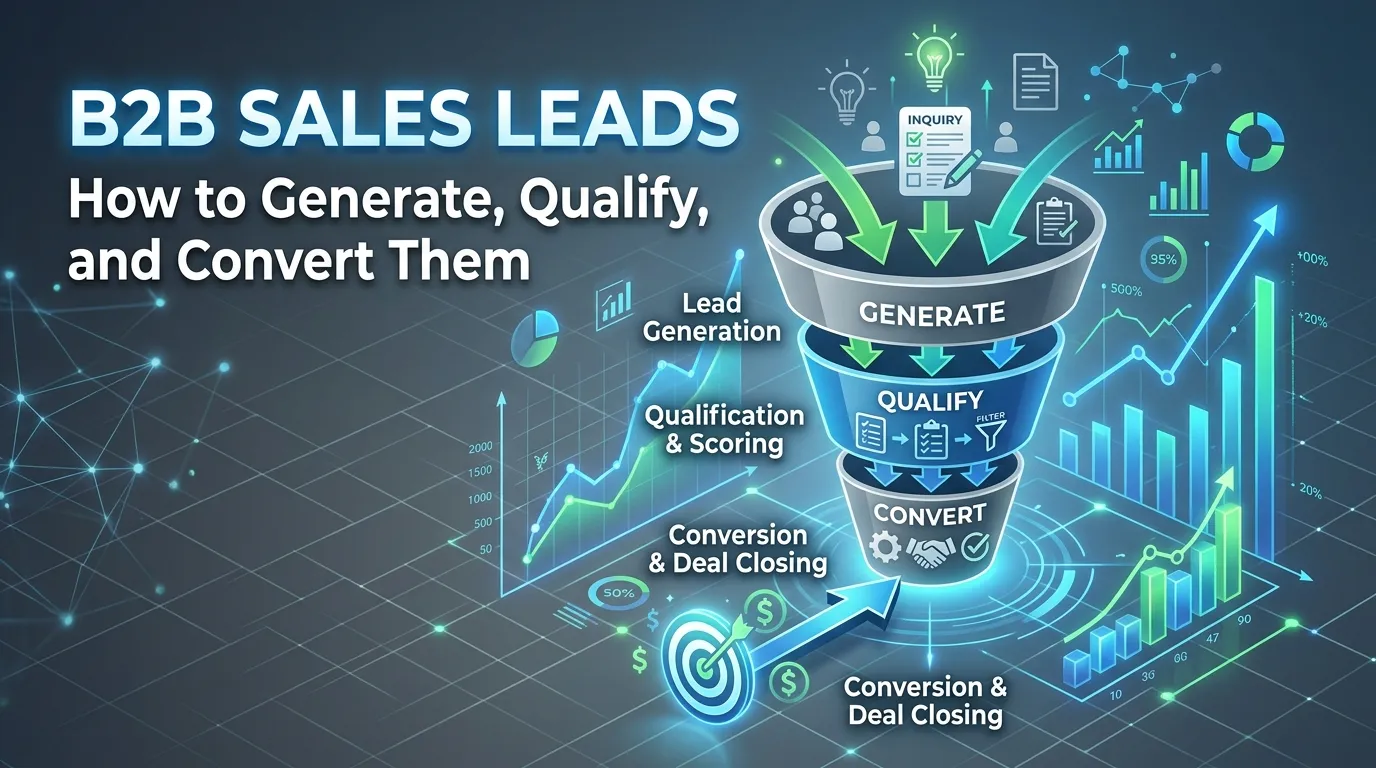
B2B sales leads are businesses or decision-makers who show interest in your product or service. To generate them, combine inbound tactics (content, SEO, social media) with outbound efforts (cold email, LinkedIn outreach), then qualify leads using clear criteria and nurture them through your sales funnel until they’re ready to buy.
Every B2B company runs on one thing: a steady flow of quality leads. Without them, your sales team has nobody to call, your pipeline dries up, and growth stalls. But generating leads that actually turn into customers? That’s where many businesses struggle.
The challenge isn’t just finding contacts. It’s finding the right contacts—people with budget, authority, and a genuine need for what you sell. A list of 10,000 unqualified leads is worth far less than 100 well-matched prospects ready to talk.
This guide breaks down everything you need to know about B2B sales leads. You’ll learn proven lead generation strategies, how to qualify prospects so you don’t waste time, and ways to optimize your sales funnel for higher conversions. Whether you’re building a process from scratch or sharpening an existing one, you’ll walk away with practical techniques you can use right now.
What are B2B sales leads, and why do they matter?
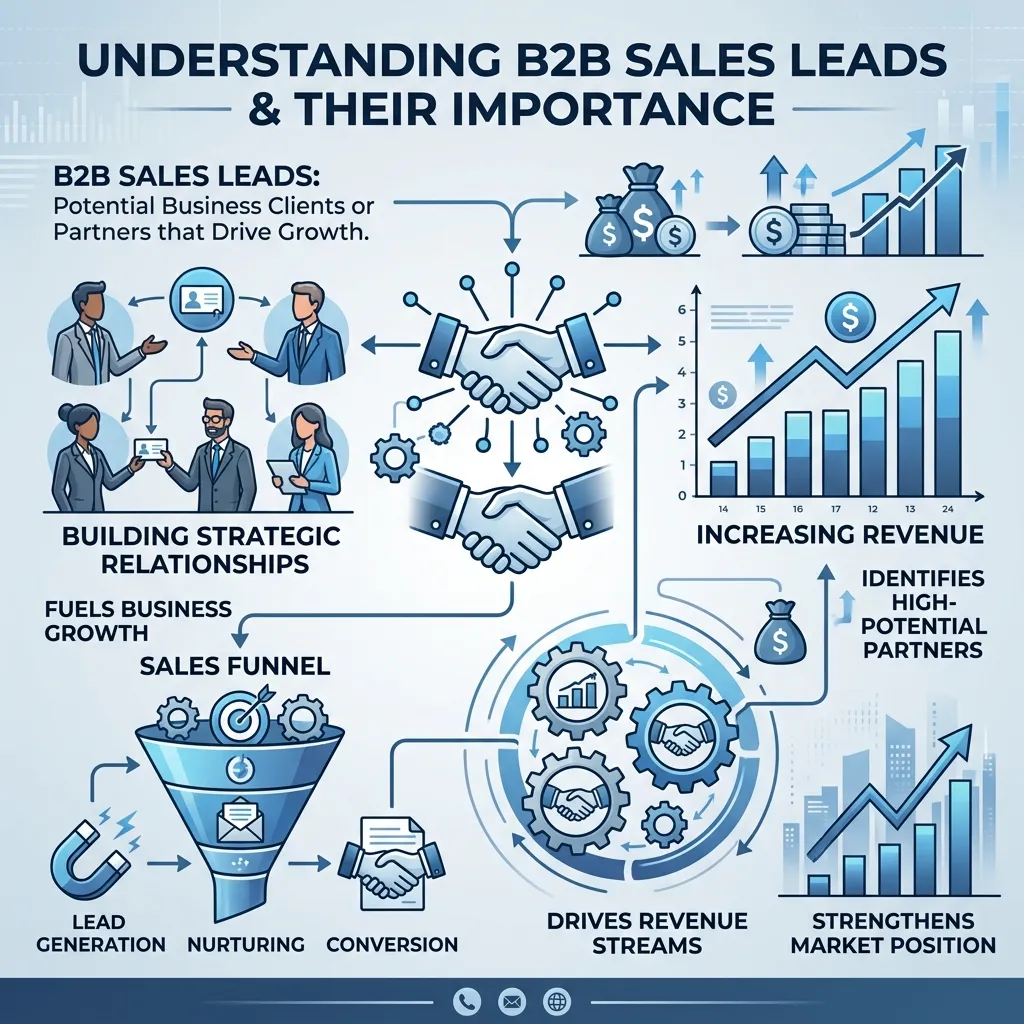
A B2B sales lead is any business or individual who shows potential interest in buying your product or service. That interest might come from downloading a whitepaper, requesting a demo, replying to a cold email, or visiting your pricing page multiple times.
Not all leads are equal, though. Some are casually browsing, while others are actively comparing vendors. Understanding where each lead sits in their buying journey helps your team focus energy where it counts.
Strong lead generation matters because B2B sales cycles are long and complex. According to Gartner, a typical buying group for a complex B2B solution involves six to ten decision-makers. That means you’re rarely selling to one person—you’re influencing an entire committee. The more qualified leads you bring in, the better your odds of navigating those groups successfully.
For a broader foundation on this topic, see what is lead generation in business.
What are the best B2B lead generation strategies?
There’s no single “best” way to generate leads. The most successful B2B companies layer multiple strategies so they’re never dependent on one channel. You can explore a full breakdown of proven approaches in top B2B lead generation strategies for growth.
B2B inbound lead generation
Inbound lead generation pulls prospects toward you by offering something valuable. Instead of chasing buyers, you attract them with content and resources that solve their problems.
Common inbound tactics include:
- Content marketing: Blog posts, guides, and case studies that answer your audience’s questions and rank in search engines.
- SEO: Optimizing your site so prospects find you when they search for solutions you offer.
- Lead magnets: Gated resources like templates, ebooks, or webinars that prospects exchange their contact details to access.
- Social media: Sharing insights on LinkedIn and other platforms where your buyers spend time.
Inbound works best for companies playing the long game. It takes time to build momentum, but once content starts ranking and circulating, it generates leads around the clock without ongoing ad spend.
B2B outbound sales leads
Outbound lead generation flips the script—you reach out to prospects directly rather than waiting for them to find you. It’s proactive, faster to start, and gives you control over who you target.
Effective outbound methods include:
- Cold email: Personalized, well-researched emails sent to prospects who fit your ideal customer profile.
- LinkedIn outreach: Connecting with decision-makers and starting conversations through thoughtful messaging.
- Cold calling: Still effective in many industries, especially for high-value deals.
- Account-based marketing (ABM): Targeting specific high-value accounts with tailored campaigns across multiple channels.
Choose outbound if you need leads quickly or sell to a narrow, well-defined market. The downside is that it requires consistent effort and tends to have lower response rates than inbound, so volume and personalization both matter.
How do you generate B2B sales leads step by step?
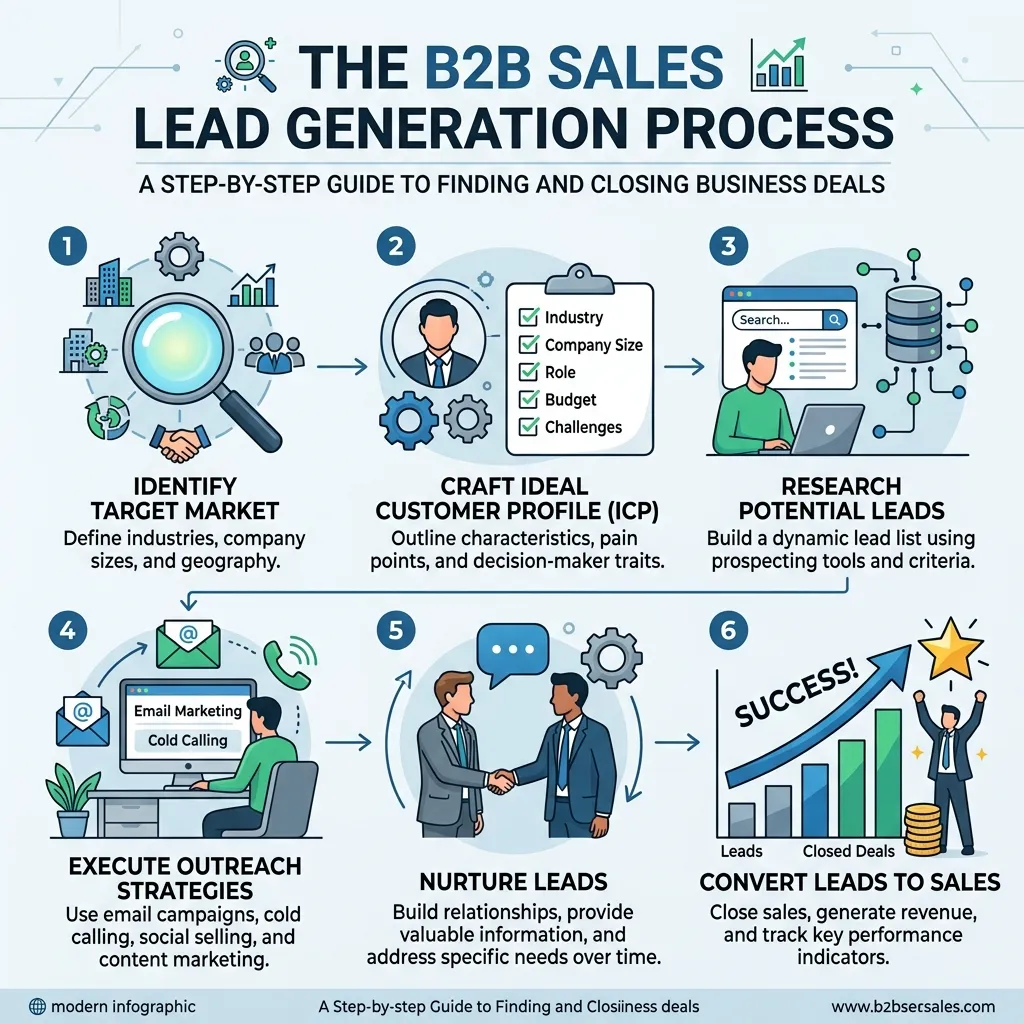
Generating leads becomes far easier when you follow a repeatable process. You can also explore an expanded framework in how to generate leads online strategies. Here’s a framework you can adapt to your business.
Step 1: Define your ideal customer profile (ICP)
Before you generate a single lead, get clear on who you’re targeting. Your ICP describes the type of company that benefits most from your product—think industry, company size, revenue, location, and the specific roles you sell to. A sharp ICP keeps your efforts focused and prevents wasted time on poor-fit prospects.
Step 2: Build targeted prospect lists
Use your ICP to build lists of companies and contacts that match. Tools like LinkedIn Sales Navigator, ZoomInfo, and Apollo make it easier to find verified contact details and filter prospects by criteria that matter to you.
Step 3: Create valuable content and offers
Whether you’re going inbound or outbound, you need something worth engaging with. That could be a blog post answering a common pain point, a free tool, or a compelling reason to book a demo. The offer should speak directly to the problem your prospects face.
Step 4: Choose your outreach channels
Decide where you’ll reach prospects—email, LinkedIn, phone, or a mix. Multi-channel outreach typically outperforms single-channel efforts because it increases the number of touchpoints with each prospect.
Step 5: Capture and track leads
Set up landing pages, forms, and a CRM to capture lead information and track every interaction. Without a system to organize leads, even great campaigns fall apart.
What are effective B2B prospecting methods?
Prospecting is the active hunt for new leads. Strong prospecting blends research with outreach so your messages land with the right people at the right time.
A few methods that consistently work:
- Trigger-based outreach: Reach out when a company shows a buying signal—new funding, a leadership hire, expansion, or a relevant job posting.
- Referral asks: Request introductions from happy customers and partners. Referred leads close faster and at higher rates.
- Social selling: Build relationships on LinkedIn by sharing useful content and engaging with prospects’ posts before pitching.
- Intent data: Use tools that reveal which companies are actively researching solutions like yours, so you can prioritize warm prospects.
The thread connecting all these methods is relevance. The more specific and timely your outreach, the better your results.
How do you qualify B2B sales leads?
Generating leads is only half the battle. Qualifying them ensures your sales team spends time on prospects likely to buy. Qualified B2B sales leads share three traits: a real need, the budget to buy, and the authority to make or influence a decision.
A popular framework for this is BANT:
- Budget: Can they afford your solution?
- Authority: Are you talking to a decision-maker or influencer?
- Need: Do they have a problem your product solves?
- Timeline: When are they looking to make a decision?
You can also separate leads into two stages. Marketing qualified leads (MQLs) have shown interest but aren’t ready to buy. Sales qualified leads (SQLs) have been vetted and are ready for a direct sales conversation. Moving leads from MQL to SQL is where lead nurturing comes in.
What are the best B2B lead nurturing strategies?
Most leads aren’t ready to buy the moment they enter your pipeline. Lead nurturing keeps them engaged until they are, building trust and staying top of mind throughout a long buying cycle.
Effective nurturing strategies include:
- Email drip campaigns: Automated sequences that deliver relevant content based on a lead’s behavior and stage.
- Personalized follow-ups: Tailored messages that reference a prospect’s specific situation rather than generic check-ins.
- Educational content: Sharing case studies, comparison guides, and resources that help prospects make confident decisions.
- Retargeting ads: Staying visible to leads who’ve visited your site but haven’t converted yet.
The goal is to add value at every touchpoint. When you consistently help prospects solve problems, you earn the right to their business when they’re finally ready.
How do you optimize your B2B sales funnel?
Your sales funnel maps the journey from first contact to closed deal. Optimizing it means finding and fixing the spots where leads drop off.
Start by measuring conversion rates at each stage—how many visitors become leads, how many leads become MQLs, how many MQLs become SQLs, and so on. Wherever you see a steep drop, that’s your priority.
A few ways to tighten your funnel:
- Speed up follow-up: Responding to inbound leads within minutes dramatically increases your chances of connecting.
- Align sales and marketing: Make sure both teams agree on what a qualified lead looks like and hand off leads smoothly.
- Simplify your forms: Fewer fields mean higher conversion rates on landing pages.
- Test and refine: Continuously A/B test emails, landing pages, and calls to action to improve performance over time.
Small improvements at each stage compound. Lifting your funnel conversion by even a few percentage points can meaningfully grow your revenue.
What are the best B2B lead generation tools?
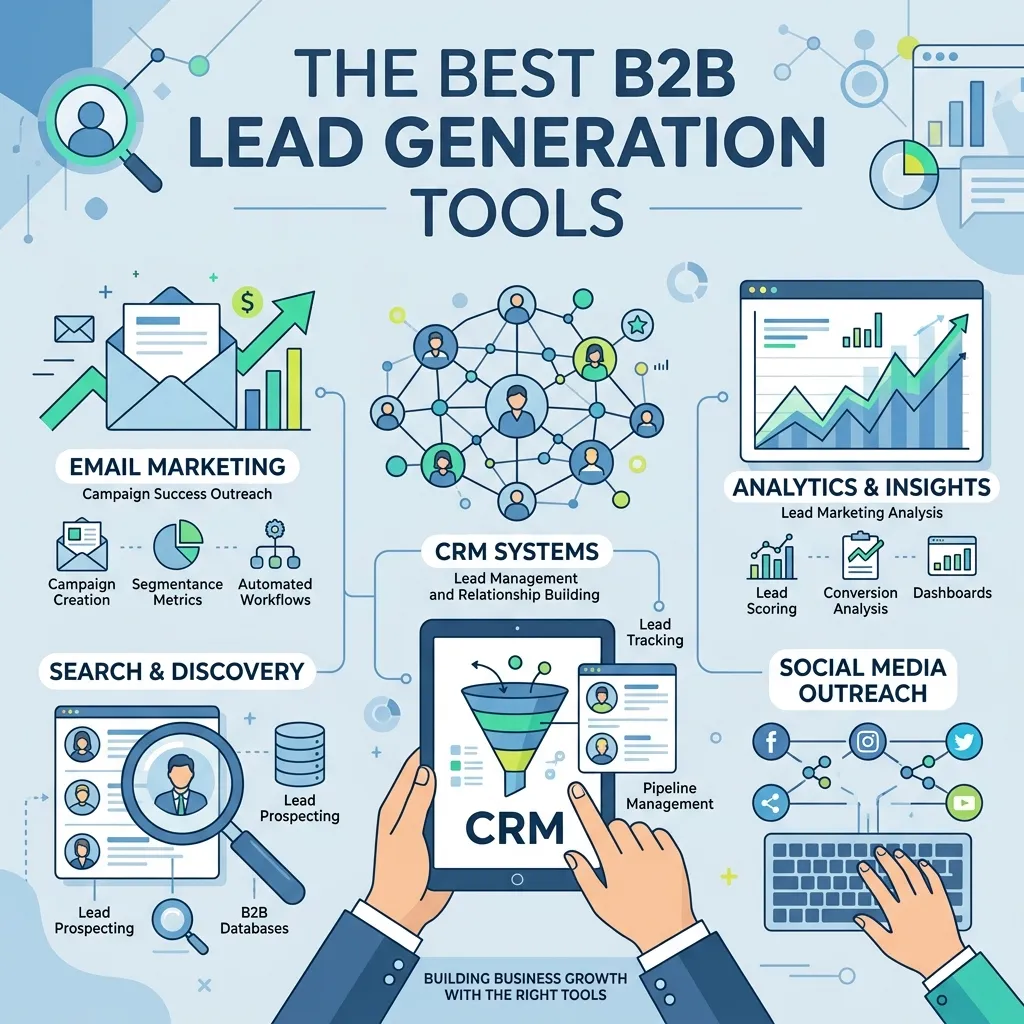
The right tools make every part of lead generation faster and more accurate. Here are categories worth investing in:
- CRM platforms (HubSpot, Salesforce, Pipedrive): Organize leads, track interactions, and manage your pipeline in one place.
- Prospecting databases (ZoomInfo, Apollo, LinkedIn Sales Navigator): Find verified contact details and build targeted lists.
- Email outreach tools (Outreach, Lemlist, Instantly): Automate and personalize cold email campaigns at scale.
- Marketing automation (Marketo, ActiveCampaign): Run nurture sequences and score leads automatically.
- Intent data providers (Bombora, 6sense): Identify companies actively researching your category.
Start with a solid CRM and one prospecting tool, then add to your stack as your process matures. Tools amplify a good strategy—they won’t fix a broken one.
Turn your leads into lasting revenue
Generating B2B sales leads isn’t about chasing every contact you can find. It’s about attracting the right prospects, qualifying them carefully, and guiding them through a funnel built to convert. The companies that win are those that combine inbound and outbound strategies, nurture leads patiently, and measure what’s working at every stage.
Start by defining your ideal customer profile and choosing one or two strategies to focus on. Build a simple, repeatable process before layering in more channels and tools. Then refine relentlessly—because lead generation is never finished, only improved.
Ready to take the next step? Audit your current funnel, find your biggest drop-off point, and fix it first. That single change could be the difference between a pipeline that trickles and one that flows.
Frequently asked questions
What’s the difference between a lead and a prospect in B2B sales?
A lead is any contact who has shown some interest in your product, often by sharing their details or engaging with your content. A prospect is a lead who has been qualified—meaning they match your ideal customer profile and have a realistic chance of buying. Every prospect starts as a lead, but not every lead becomes a prospect.
How long does it take to generate B2B sales leads?
It depends on your approach. Outbound methods like cold email and LinkedIn outreach can produce leads within days or weeks. Inbound methods like SEO and content marketing take longer—often three to six months—to gain traction, but they generate leads consistently once established. Most companies blend both for short-term wins and long-term stability.
How much do B2B leads cost?
Cost varies widely by industry, channel, and target market. Inbound leads generally cost less over time because content keeps working after it’s published, while outbound and paid ad campaigns require ongoing spend. Rather than focusing only on cost per lead, measure cost per qualified lead and, ultimately, cost per closed deal.
What is a good conversion rate for B2B leads?
B2B conversion rates vary by stage and industry, so there’s no universal benchmark. Instead of chasing a single number, track your own conversion rates at each funnel stage, set baselines, and work to improve them over time. Steady improvement matters more than hitting an arbitrary target.
Should I focus on inbound or outbound lead generation?
It depends on your goals and resources. Choose outbound if you need leads quickly or sell to a small, well-defined market. Choose inbound if you can invest in content and want a sustainable, lower-cost source of leads over time. Most successful B2B companies use both, balancing immediate pipeline needs with long-term growth.
What are B2B sales leads?
B2B sales leads are businesses or decision-makers who show interest in a company’s product or service and may become potential customers.
How do you generate B2B sales leads?
You can generate leads using inbound methods like SEO and content marketing, and outbound methods like cold email, LinkedIn outreach, and cold calling.
What is the difference between inbound and outbound B2B leads?
Inbound leads come from organic interest (content, search, social), while outbound leads are generated through direct outreach to potential customers.
What makes a high-quality B2B sales lead?
A high-quality lead has budget, decision-making authority, a clear need, and a defined timeline to purchase.
What is lead qualification in B2B sales?
Lead qualification is the process of evaluating leads to determine if they are a good fit for your product based on criteria like BANT (Budget, Authority, Need, Timeline).
What tools are used for B2B lead generation?
Common tools include CRMs like HubSpot and Salesforce, prospecting tools like LinkedIn Sales Navigator, and outreach tools like Apollo or Lemlist.
How does lead nurturing work in B2B sales?
Lead nurturing involves sending targeted emails, content, and follow-ups to build trust and move leads closer to a buying decision.
What is a good B2B lead conversion rate?
It varies by industry, but improving conversion rates at each stage of the funnel is more important than hitting a fixed benchmark.
Why do B2B sales leads matter for business growth?
They are essential for maintaining a healthy sales pipeline, increasing revenue, and ensuring consistent business growth over time.



Leave a Reply