


Every marketing dollar matters. You’re tracking clicks, impressions, and conversions, but are you measuring the one metric that directly connects your marketing spend to sales opportunities? Cost per lead (CPL) reveals exactly how much you’re paying for each potential customer who enters your sales funnel.
Understanding CPL helps you allocate your marketing budget more effectively, identify which channels deliver the highest-quality prospects, and ultimately improve your return on investment. Whether you’re running Google Ads, creating content, or investing in trade shows, knowing your cost per lead empowers you to make data-driven decisions about where to focus your efforts.
What is Cost Per Lead?

Cost per lead measures the average amount you spend to acquire one qualified prospect for your business. This metric divides your total marketing expenditure by the number of leads generated during a specific period.
A lead typically represents someone who has shown interest in your product or service by providing contact information, downloading a resource, requesting a demo, or taking another qualifying action. The key distinction is that leads are potential customers who have engaged with your brand beyond just viewing your content.
CPL differs from other marketing metrics like cost per click (CPC) or cost per impression (CPM) because it focuses on conversion outcomes rather than traffic volume. While CPC tells you how much you pay for website visitors, CPL reveals the actual cost of turning those visitors into sales prospects.
For example, if you spend $1,000 on a marketing campaign that generates 50 qualified leads, your cost per lead is $20. This simple calculation provides immediate insight into your marketing efficiency and helps you compare the effectiveness of different channels.
How to Calculate Cost Per Lead
The basic cost per lead formula is straightforward:
Cost Per Lead = Total Marketing Spend ÷ Number of Leads Generated
However, accurate CPL calculation requires careful consideration of what expenses to include and how to define a qualified lead.
Determining Total Marketing Spend
Your total marketing spend should encompass all costs associated with lead generation activities:
- Advertising costs: Paid search, display ads, social media advertising
- Content creation: Writing, design, video production
- Software and tools: Marketing automation platforms, CRM systems, analytics tools
- Personnel costs: Marketing team salaries, contractor fees
- Event expenses: Trade shows, webinars, networking events
Some businesses calculate CPL using only direct advertising spend, while others include the full marketing budget. Choose the approach that aligns with your business goals and reporting needs, but remain consistent across campaigns for accurate comparisons.
Defining Qualified Leads
Not all leads carry equal value. A qualified lead has demonstrated genuine interest and meets specific criteria that indicate sales potential. These criteria might include:
- Demographic fit: Target company size, industry, or geographic location
- Behavioral indicators: Downloaded multiple resources, visited pricing pages, engaged with sales content
- BANT qualification: Budget, Authority, Need, and Timeline alignment
Focusing on qualified leads rather than raw lead volume provides a more accurate picture of marketing effectiveness and ensures your CPL calculations reflect actual business value.
Industry Benchmarks for Cost Per Lead
Cost per lead varies significantly across industries, marketing channels, and business models. Understanding typical benchmarks helps you evaluate your performance and set realistic goals.
B2B vs B2C Differences
B2B companies typically see higher costs per lead due to longer sales cycles, smaller target audiences, and higher customer lifetime values. B2B CPL often ranges from $50 to $500, while B2C businesses might achieve costs between $10 and $100.
These differences reflect the complexity of B2B purchasing decisions, which often involve multiple stakeholders and extensive research periods. B2C transactions, while potentially lower in individual value, typically move faster through the sales funnel.
Channel-Specific Benchmarks
Different marketing channels deliver varying cost per lead results:
Google Ads: Generally ranges from $20 to $200, depending on keyword competition and industry
Facebook Ads: Typically costs $15 to $150 per lead, with highly targeted campaigns performing better
LinkedIn Ads: Often higher at $50 to $300, but delivers more qualified B2B prospects
Email Marketing: Usually achieves the lowest CPL at $5 to $50, leveraging existing relationships
Content Marketing: Varies widely from $10 to $300, depending on content quality and distribution strategy
Remember that these benchmarks serve as general guidelines. Your specific results will depend on factors like target audience, competition level, and campaign optimization.
Factors That Influence Cost Per Lead
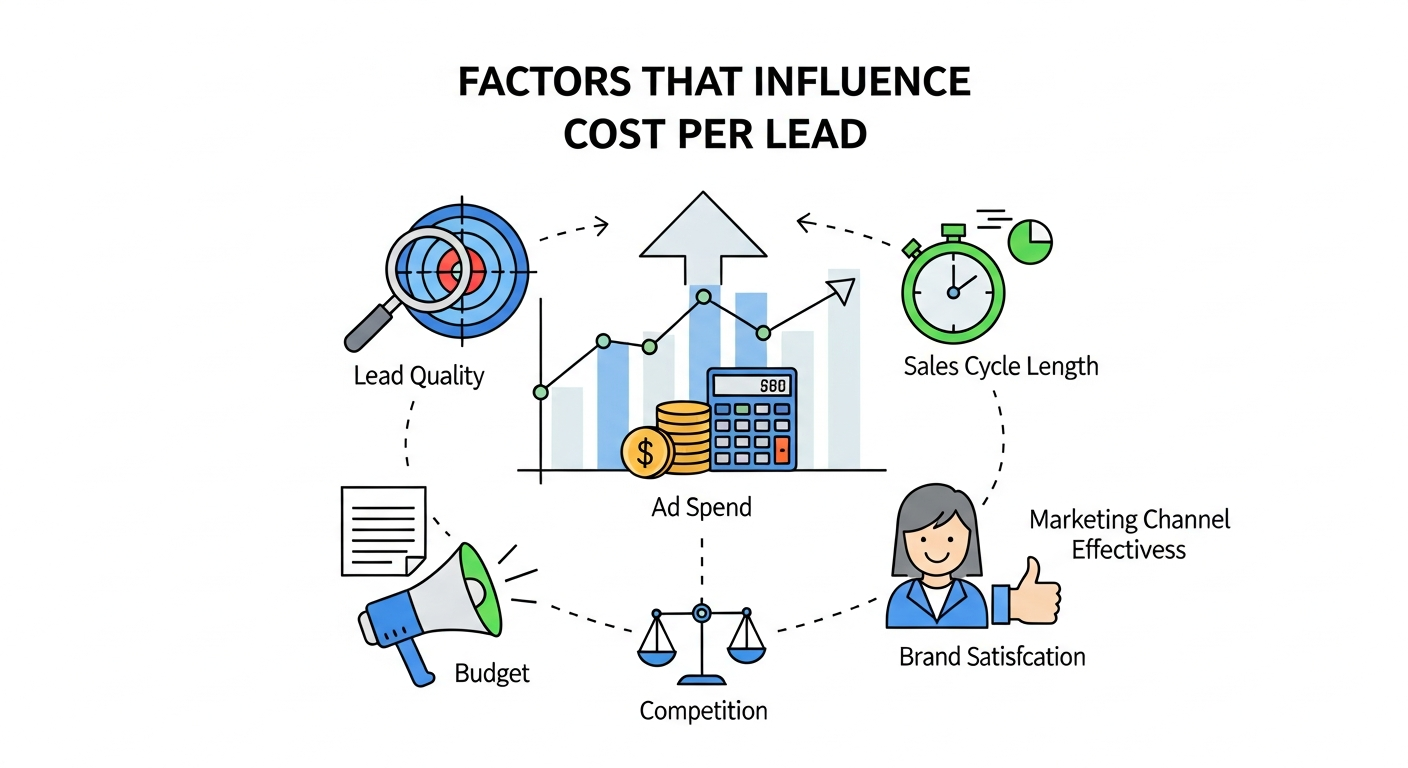
Multiple variables impact your cost per lead, and understanding these factors helps you optimize your marketing spend more effectively.
Target Audience Characteristics
Highly specific audiences typically cost more to reach but often convert at higher rates. Targeting executives at Fortune 500 companies will likely cost more per lead than reaching small business owners, but the potential deal size may justify the increased investment.
Geographic targeting also affects costs. Major metropolitan areas and competitive markets usually have higher CPL due to increased advertiser competition and higher living costs.
Competition Level
Industries with intense competition see higher costs per lead as businesses bid against each other for the same audience attention. Legal services, insurance, and financial planning often experience particularly high CPL due to strong competition and high customer lifetime values.
Seasonal factors can temporarily increase competition. Tax services see higher CPL during tax season, while retail businesses face increased costs during holiday shopping periods.
Marketing Channel Selection
Each marketing channel has different cost structures and effectiveness levels. Paid advertising typically delivers faster results but at higher per-lead costs. Organic content marketing might achieve lower CPL over time, but requires significant upfront investment and patience.
The quality of leads can vary dramatically between channels. Search engine marketing often generates high-intent leads since people actively search for solutions. Social media advertising might produce more top-of-funnel leads that require additional nurturing.
Landing Page and Form Optimization
Your landing page design and lead capture forms directly impact conversion rates, which affects CPL. A well-optimized landing page that converts 10% of visitors will achieve half the cost per lead of a page that converts only 5%.
Form length presents a particular challenge. Shorter forms typically generate more leads but may sacrifice lead quality. Longer forms collect more qualification information but might reduce conversion rates. Testing different approaches helps you find the optimal balance for your specific situation.
Strategies to Reduce Cost Per Lead
Lowering your cost per lead without sacrificing lead quality requires systematic testing and optimization across multiple areas of your marketing funnel.
Improve Targeting and Segmentation
Refined targeting helps you reach the most likely prospects while avoiding wasted spend on unqualified traffic. Use demographic data, behavioral insights, and customer feedback to create detailed buyer personas.
Negative keywords in search campaigns prevent your ads from showing for irrelevant searches. Adding terms like “free,” “cheap,” or “DIY” can help filter out bargain hunters who are unlikely to convert into paying customers.
Lookalike audiences on social media platforms leverage your existing customer data to find similar prospects. These audiences often deliver lower CPL than broader targeting options because they’re based on proven conversion patterns.
Optimize Landing Pages and User Experience
Landing page optimization can dramatically impact your cost per lead. Focus on alignment between your ads and landing page content to reduce bounce rates and improve conversion rates.
Clear value propositions explain exactly what visitors receive in exchange for their contact information. Vague promises like “learn more” perform poorly compared to specific offers like “download our 47-point SEO checklist.”
Social proof elements such as customer testimonials, case studies, or trust badges build credibility and encourage form submissions. Display recognizable company logos or specific results to demonstrate your track record.
Mobile optimization is critical since many prospects browse on smartphones. Ensure forms load quickly, display properly on small screens, and minimize typing requirements.
Leverage Content Marketing and SEO
Content marketing can achieve lower long-term CPL by attracting organic traffic and building relationships with prospects over time. High-quality blog posts, guides, and resources establish your expertise while generating leads without ongoing advertising costs.
Search engine optimization amplifies content marketing efforts by helping your resources rank higher in search results. Targeting long-tail keywords often costs less than competing for broad, high-volume terms while attracting more qualified traffic.
Email marketing to existing subscribers typically delivers the lowest cost per lead since you’re reaching people who have already expressed interest in your brand. Regular newsletters, educational content, and exclusive offers keep your business top-of-mind when prospects are ready to buy.
Test and Optimize Continuously
A/B testing reveals which elements of your lead generation system perform best. Test one variable at a time to isolate the impact of each change:
- Headlines and ad copy: Different value propositions and emotional appeals
- Call-to-action buttons: Colors, text, and placement variations
- Form fields: Number of fields, required vs. optional information
- Images and videos: Professional photos vs. illustrations, testimonial videos vs. product demos
Set up proper tracking to measure not just lead volume but lead quality metrics like sales conversion rates and customer lifetime value. A channel that generates cheaper leads but lower-quality prospects may not deliver the best overall ROI.
Measuring and Tracking Cost Per Lead
Effective CPL tracking requires proper systems and consistent measurement practices that provide actionable insights for optimization.
Essential Tracking Tools
Google Analytics provides free lead tracking capabilities through goal setting and conversion tracking. Set up goals for form submissions, phone calls, and other lead generation events to monitor performance across different traffic sources.
Marketing automation platforms like HubSpot, Marketo, or Pardot offer more sophisticated tracking that follows leads through the entire sales funnel. These tools can calculate CPL for specific campaigns and show how leads progress toward becoming customers.
CRM integration ensures accurate lead counting and helps you track which marketing sources produce the highest-quality prospects. Connect your marketing tools to your sales system to measure not just lead cost but also lead value.
Attribution Models
Attribution models determine how you assign credit for leads that result from multiple touchpoints. A prospect might discover your business through a blog post, return via a Google search, and finally convert through a Facebook ad.
First-touch attribution gives credit to the initial interaction, which helps you understand awareness-building activities. Last-touch attribution credits the final touchpoint before conversion, highlighting which channels close deals most effectively.
Multi-touch attribution distributes credit across multiple interactions, providing a more complete picture of your marketing funnel. This approach helps you optimize the entire customer journey rather than focusing on individual channels.
Key Performance Indicators
Beyond basic CPL calculations, track these related metrics for deeper insights:
Lead-to-customer conversion rate shows how many leads eventually become paying customers. This helps you identify which channels generate the most valuable prospects.
Customer acquisition cost (CAC) includes all marketing and sales expenses required to acquire a new customer. While CPL focuses on marketing efficiency, CAC provides a complete picture of acquisition costs.
Return on ad spend (ROAS) measures revenue generated per dollar spent on marketing. This metric helps you understand the bottom-line impact of your lead generation efforts.
Lead velocity tracks how quickly leads move through your sales funnel. Faster-converting leads often have lower total acquisition costs since they require less nurturing.
Advanced Cost Per Lead Optimization

Sophisticated optimization techniques can help established businesses achieve significant improvements in lead generation efficiency.
Multi-Channel Attribution
Advanced attribution models help you understand how different marketing channels work together to generate leads. A prospect might read your blog post, see a retargeting ad, and then convert through email marketing. Simple last-click attribution would credit email marketing entirely, potentially leading to misguided budget allocation.
Marketing mix modeling uses statistical analysis to determine the contribution of each channel to overall lead generation. This approach accounts for interactions between channels and helps you optimize your complete marketing portfolio rather than individual campaigns.
Lead Scoring and Quality Assessment
Lead scoring systems assign numerical values to prospects based on demographic information and behavioral data. Higher scores indicate stronger sales potential, allowing you to calculate cost per qualified lead rather than cost per raw lead.
Effective scoring models consider factors like company size, job title, website engagement, and content downloads. Regular calibration ensures your scoring criteria align with actual sales outcomes.
Feedback loops between marketing and sales teams improve lead quality over time. Track which leads convert to customers and identify common characteristics that can refine your targeting and scoring approaches.
Lifetime Value Optimization
Cost per lead becomes more meaningful when considered alongside customer lifetime value (CLV). A lead that costs $200 but becomes a customer worth $10,000 over three years provides excellent ROI. Conversely, a $20 lead that generates a $500 one-time purchase may be less valuable.
Calculate CPL-to-LTV ratios for different channels and campaigns. Channels with higher CPL might be justified if they consistently generate more valuable customers. This analysis helps you make strategic budget allocation decisions based on long-term profitability rather than short-term efficiency metrics.
Start Optimizing Your Lead Generation Costs
Cost per lead serves as a crucial metric for marketing accountability and optimization. By understanding your true lead generation costs and continuously testing improvements, you can maximize the return on your marketing investment while building a sustainable pipeline of sales opportunities.
Begin by establishing baseline CPL measurements for your current marketing activities. Implement proper tracking systems, define clear lead qualification criteria, and start testing optimization strategies one at a time. Focus on the channels and tactics that deliver the best combination of lead volume, quality, and cost efficiency for your specific business goals.
Remember that the lowest cost per lead isn’t always the best outcome. Balance cost considerations with lead quality, sales conversion rates, and customer lifetime value to create a lead generation system that drives profitable growth for your business.
Conclusion
Cost per lead is one of the most practical metrics for evaluating marketing efficiency and guiding budget decisions. It connects spending directly to opportunity creation and reveals which channels truly deliver value. By focusing on lead quality, alignment, optimization, and long-term profitability, businesses can use CPL not just to measure performance—but to drive sustainable growth.
Frequently Asked Questions (FAQ)
1. What is Cost Per Lead (CPL)?
Cost Per Lead is a marketing metric that calculates how much money you spend to generate one potential customer who has shown interest in your product or service.
2. How is CPL different from CPC and CPA?
CPL measures the cost of acquiring leads, CPC focuses on website clicks, and CPA tracks the cost of converting a lead into a paying customer.
3. What is considered a good CPL?
A good CPL depends on your industry, target audience, and customer lifetime value. Higher-value products can justify a higher CPL.
4. Why is my CPL increasing over time?
CPL may rise due to increased competition, poor targeting, weak landing pages, or changes in platform algorithms.
5. Should I focus on lowering CPL at all costs?
No. A lower CPL is meaningless if lead quality drops. Focus on generating qualified leads that convert into revenue.
6. Which marketing channels usually have the lowest CPL?
Email marketing, SEO, and content marketing often deliver lower CPL compared to paid advertising, especially over time.
7. How can I reduce CPL without hurting lead quality?
Improve audience targeting, optimize landing pages, refine messaging, and use lead scoring to focus on high-intent prospects.
8. How often should CPL be tracked and analyzed?
CPL should be reviewed regularly—weekly for paid campaigns and monthly for overall marketing performance.
9. Does CPL vary between B2B and B2C businesses?
Yes. B2B CPL is typically higher due to longer sales cycles and higher customer value, while B2C CPL is usually lower.
10. What tools can help track Cost Per Lead accurately?
Google Analytics, CRM systems, and marketing automation platforms like HubSpot help track CPL and lead quality effectively.
11. How does CPL impact overall business growth?
CPL influences budget planning, revenue forecasting, and scalability. Optimized CPL leads to sustainable growth and higher marketing ROI.



Leave a Reply