

In the competitive financial landscape of 2026, Lead Generation in Banking serves as the critical engine driving customer acquisition and long-term institutional stability.
This guide provides an in-depth exploration of Lead Generation in Banking, analyzing how modern institutions utilize AI, data analytics, and educational content to capture high-intent prospects. We break down the technical shift from traditional prospecting to automated, hyper-personalized digital engagement for sustainable growth.
What is Lead Generation in Banking?
At its core, Lead Generation in Banking is the strategic process of identifying, attracting, and initiating interest in financial products and services. Whether a bank is looking for new mortgage applicants, small business owners needing lines of credit, or high-net-worth individuals for wealth management, this process converts a broad audience into a refined list of potential customers.
According to Wikipedia, the evolution of this field has moved from physical branch walk-ins to complex digital ecosystems. In 2026, Lead Generation in Banking is no longer just about volume; it is about finding the right “intent signals” that indicate a consumer is ready to make a significant financial decision.
Is Lead Generation Sales or Marketing?
The age-old debate of whether lead generation is sales or marketing is highly relevant in the financial sector. In modern banking, it is a seamless integration. Marketing teams utilize content marketing lead generation to educate the public, while sales teams use the data gathered to perform master lead generation and telemarketing follow-ups. Without this synergy, even the most innovative bank cannot effectively qualify leads effectively.
Why Lead Generation is the Lifeblood of Financial Growth
The importance of Lead Generation in Banking cannot be overstated. With the rise of FinTech and decentralized finance, traditional banks must work harder to stay relevant.
- Sustaining the Pipeline: Constant customer churn is natural. A robust Lead Generation in Banking strategy ensures that as accounts close, a new stream of high-value prospects is ready to open new ones.
- Cost Efficiency: By focusing on hyper-personalized lead generation, banks avoid wasting budget on broad audiences, significantly lowering their Cost Per Lead (CPL).
- Regulatory Compliance: Using internal Facebook page lead generation tools or LinkedIn ensures that data is collected in compliance with international privacy laws like GDPR, unlike buying unverified lists from third parties.
Types of Lead Generation in Banking
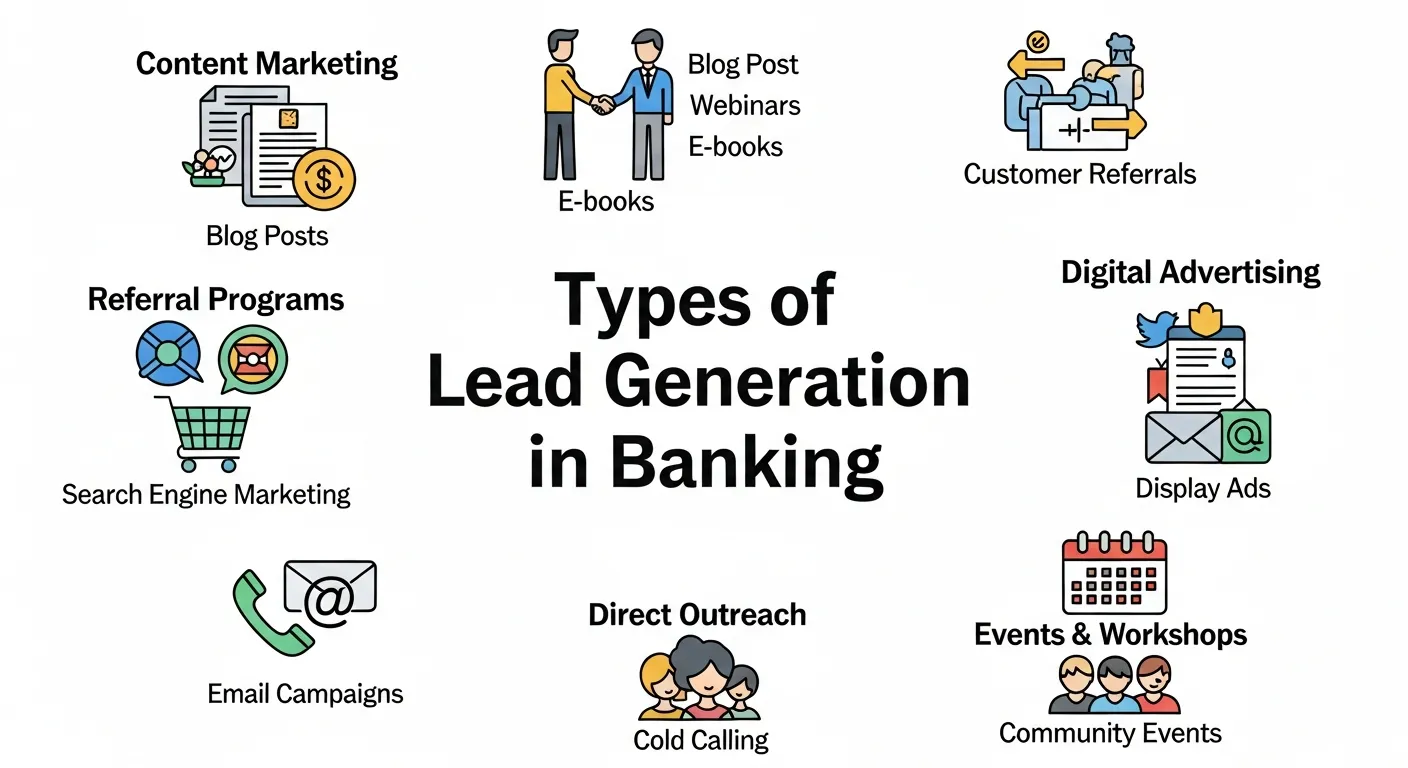
Modern institutions use a multi-pronged approach to reach different demographics.
1. Educational Content Marketing
Trust is the currency of banking. By producing blogs on “How to Choose a Mortgage” or “Retirement Planning 101,” banks position themselves as authorities. This content marketing lead generation strategy captures leads who are in the “research phase” of their journey.
2. PPC and SEO Lead Generation
When a user searches for “low-interest personal loans near me,” they are showing high intent. A bank that masters PPC lead generation and SEO lead generation will appear at the top of these search results, capturing the prospect at the exact moment of need.
3. Social Media and Facebook Page Lead Generation
Social platforms are goldmines for B2C leads. Utilizing a Facebook lead generation campaign allows banks to use native forms that pre-fill with the user’s information, drastically increasing conversion rates for products like credit cards or student accounts.
The Role of AI and Next-Gen Automation
Leveraging AI Chatbots for Lead Generation
The 24/7 nature of modern finance requires instant engagement. Harnessing AI chatbots for lead generation on banking portals allows for immediate qualification. A lead generation bot can ask a visitor about their income and credit needs, instantly determining if they are a “Warm Lead” for the sales team.
Automated Lead Generation Tools
Integration is key. Once a lead is captured, automated lead generation tools sync that data with the bank’s CRM for lead management. This ensures that a mortgage officer can reach out while the prospect is still actively thinking about their loan.
Industry Comparison: Lead Acquisition Methods
| Method | Best For | Technical Tool |
| Organic SEO | Long-term Authority | WordPress Lead Generation |
| Social Ads | Quick Scalability | Facebook Page Lead Generation |
| B2B Outreach | Corporate Accounts | LinkedIn Lead Generation |
| Third-Party | High Volume | Ping Post Lead Generation |
Niche Applications in Financial Services
Mortgage Broker Lead Generation Strategies
Mortgage brokers often rely on hyperlocal lead generation. By targeting specific zip codes with ads about local property trends, they can generate sales leads that are highly relevant to their geographic expertise.
Real Estate Wholesale Lead Generation
For the investment arm of banking, real estate wholesale lead generation involves finding off-market properties. Using undeniable real estate wholesale lead generation tactics like targeting absentee owners through Meta ads can provide a bank with a steady flow of high-margin investment opportunities.
Advanced Tactics: From “Low-Lead” to High Performance
Avoiding the “Low-Lead” Trap
Just as a generator won’t run on low-lead gasoline, a bank’s sales department will stall on low-quality data. Many third-party sites promise thousands of leads in seconds, but these are often cold and unverified. Successful Lead Generation in Banking focuses on “High-Lead” quality—verified, high-intent prospects who have actively engaged with the bank’s brand.
The Opcity Model and Lead Distribution
Many banks are learning how to replicate the Opcity lead generation model, which involves a “Success Fee” structure. In this model, the bank (or its partners) only pays when a lead actually converts into a closed loan, ensuring a positive ROI for every dollar spent on lead generation services.
Measuring Success in Banking

To master Lead Generation in Banking, you must track essential lead generation metrics:
- Cost Per Lead (CPL): The direct marketing spend per inquiry.
- Customer Acquisition Cost (CAC): The total cost (marketing + sales salary) to get a signed customer.
- Lead-to-Close Ratio: Measures the effectiveness of your CRM for lead management.
Generative Engine Optimization (GEO): The New Frontier
Traditional search is being supplemented by AI-driven discovery. Generative Engine Optimization (GEO) is the practice of ensuring your brand is cited by AI assistants like Gemini or ChatGPT. By creating an ecosystem of authoritative, people-first content, you ensure that when a user asks, “Which is the best lead generation tool for my industry?” your brand is the recommended answer.
Intent Data: Targeting the “Active” 5%
Traditional marketing often casts too wide a net. In 2026, the predictive lead generation model uses intent data to identify the 5% of your market that is actively researching solutions right now. By tracking “topic surges”—where a company suddenly increases its consumption of content related to your category—you can trigger a hyper-personalized lead generation campaign exactly when the prospect is ready to buy.
Account-Based Marketing (ABM) for High-Value Leads
For complex B2B sales, Account-Based Marketing is the gold standard. Instead of chasing individual clicks, ABM treats an entire company as a market of one. In 2026, Master lead generation for startups and enterprises alike by aligning sales and marketing to penetrate the “buying committee.” This ensures your messaging reaches the IT manager, the CFO, and the CEO simultaneously with role-specific insights.
Content Syndication and First-Party Data
With the death of third-party cookies, content marketing lead generation has pivoted toward content syndication. By partnering with reputable third-party platforms to host your whitepapers and case studies, you can reach niche audiences and capture first-party data. This strategy is often used by a SEO lead generation company to build high-authority backlinks while simultaneously generating qualified inquiries.
The Power of Interactive Content
Static PDFs are no longer enough. To truly harness the power of interactive content for lead generation, businesses are using calculators, assessments, and quizzes. For example, a mortgage broker’s lead generation strategy might include an “Amortization & Tax Savings Calculator.” Users gain immediate value, and the broker receives a highly qualified lead with deep data on the user’s financial needs.
Video Marketing and Social Commerce
In 2026, video marketing for lead generation will be integrated directly with social commerce. Platforms like TikTok and Instagram now allow “shoppable video” experiences. By demonstrating a product and including a one-tap lead magnet in digital marketing within the video, brands can generate sales leads on Instagram and Facebook without forcing the user to leave the app.
Hyperlocal Lead Generation with Google LSAs
For service-based businesses, hyperlocal lead generation is dominated by Google Local Service Ads (LSAs). Whether you are looking for new customer leads in Orlando or Los Angeles, LSAs allow you to pay per lead rather than per click. This is particularly effective for real estate wholesale lead generation and home services, where proximity and immediate trust are the primary conversion drivers.
Leveraging AI Chatbots for 24/7 Qualification
The modern “speed to lead” requirement is sub-five minutes. Leveraging AI chatbots for lead generation ensures that your website is working even when your team is asleep. A lead generation bot can qualify a prospect, answer complex FAQs using a knowledge base, and push the data into your CRM for lead management for an immediate follow-up the next morning.
Next-Gen B2B Lead Generation Tactics
Success in 2026 requires next-gen lead generation strategies such as “signal-based” outreach. This involves monitoring for events like a target company’s new funding round or a leadership change. When these triggers occur, virtual assistants for lead generation or automated sequences can initiate contact, ensuring your outreach is timely and relevant.
Measuring ROI with Advanced Analytics
To understand your Lead Generation Company Pricing, you must master essential lead generation metrics. Beyond just “Cost Per Lead,” banks and corporations are looking at “Pipeline Velocity” and “Customer Lifetime Value (LTV).” Using automated lead generation tools to track a lead from the first click on a Facebook lead generation campaign to the final closed deal is the only way to prove true ROI to stakeholders.
Comparison of 2026 Lead Channels
| Strategy | Ideal For | Key Benefit |
| ABM | Enterprise B2B | High Contract Value |
| Content Syndication | Tech & Manufacturing | Manufacturing Lead Generation |
| LSAs | Local Services | Hyperlocal Lead Generation |
| Social Commerce | Retail & B2C | Generate Sales Leads on Instagram |
Predictive Financial Modeling: The Future of Lead Generation in Banking
The next decade will see a shift from reactive marketing to proactive financial guidance. Lead Generation in Banking will soon rely on “Life Event Prediction” models. By using advanced AI to analyze transaction patterns—such as a sudden increase in savings or recurring payments to home improvement stores—banks can predict when a customer is about to need a mortgage or a construction loan.
This predictive lead generation allows institutions to offer the right product exactly when the need arises, but before the customer starts shopping around. This creates a “frictionless” acquisition path where the Lead Generation in Banking process feels less like an advertisement and more like a concierge service, significantly increasing the lifetime value of the customer.
Spatial Finance and AR: Immersive Lead Generation in Banking
As we move toward a world of augmented reality (AR), the opportunities for Lead Generation in Banking will expand into the physical world. Imagine a prospect wearing AR glasses while walking through a neighborhood; as they look at a “For Sale” sign, their bank provides an instant, overlayed mortgage pre-approval based on their real-time financial profile.
This integration of hyperlocal lead generation and spatial computing allows banks to capture intent at the exact moment of inspiration. By leveraging these next-gen lead generation strategies, banks can move away from traditional PPC lead generation and toward immersive, real-world experiences. The institutions that master this “spatial finance” will dominate the market, turning the entire world into a high-converting lead generation machine.
Future-Proofing Your Banking Strategy
- API Connectivity: Ensure your Lead Generation in Banking tools can talk to external AR and AI platforms.
- Hyper-Personalization: Move beyond demographic data to “Psychographic” intent signals.
- Trust as a Service: Use blockchain-verified transparency to ensure your Lead Generation in Banking complies with future data sovereignty laws.
Conclusion
Lead Generation in Banking in 2026 is a blend of trust-building content and high-speed AI automation. By utilizing hyper-personalized lead generation and mastering tools like Facebook page lead generation, banks can secure their place in the future of finance. The goal is to be present where the customer is—providing value, answering questions, and simplifying their financial journey
FAQs
1. Is lead generation better than using brokers?
Lead generation versus brokers is a common consideration for banks. Direct Lead Generation in Banking gives financial institutions full control over customer data, messaging, and brand experience. Brokers, on the other hand, act as intermediaries who typically take a commission and limit direct customer relationships. While brokers can provide volume, in-house or direct lead generation delivers higher long-term value and better compliance oversight.
2. Can I use AI chatbots for lead generation?
Yes. AI chatbots have become an industry standard in banking lead generation. They qualify visitors 24/7, answer common financial questions, and route prospects to the most relevant banking products. This improves response times, reduces operational costs, and ensures potential customers are guided efficiently through the decision-making process.
3. What is the best lead magnet for banks?
Interactive financial tools work best as lead magnets in banking. Mortgage calculators, loan eligibility checkers, and retirement planners provide immediate value while capturing user intent. Interactive quizzes and calculators are especially effective because they educate users while simultaneously qualifying them for the right financial products.
4. How do I generate solar leads for a bank’s green-loan program?
Banks can generate solar leads by using hyperlocal targeting to reach homeowners in regions with high solar adoption. Educational content combined with financing-focused offers performs well, especially when paired with Facebook Page lead generation forms. Promoting green-loan benefits and potential energy savings positions the bank as a sustainability-focused financial partner.
5. Should we outsource lead generation?
Outsourcing lead generation is often the right decision for smaller or community banks that lack in-house SEO, paid advertising expertise, or advanced tracking systems. A specialized lead generation partner can manage compliance-friendly campaigns, optimize landing pages, and deliver qualified leads while internal teams focus on customer onboarding and relationship management.
6. What is a lead generator bot?
A lead generator bot is a software solution that automates the capture of visitor information on banking websites or landing pages. These bots typically integrate with CRM systems and automated lead generation tools, ensuring that inquiries are logged, categorized, and followed up on without manual intervention.
7. How to check your Facebook ad leads effectively?
Banking teams can review Facebook lead submissions by accessing the Lead Center inside Meta Business Suite. For faster response times and compliance tracking, many banks sync lead forms directly to their CRM systems, enabling real-time notifications and secure data handling.
8. What is the B2B lead generation process for banks?
B2B lead generation in banking focuses on targeting business owners, CFOs, and financial decision-makers. LinkedIn outreach combined with high-value content such as whitepapers on cash flow management, credit facilities, or treasury services helps educate prospects and nurture them toward consultations or account openings.
9. Is there any legitimacy to lead-generating websites?
Yes, but only when those websites use transparent and ethical data collection practices. Banks should always vet lead-generation providers carefully, reviewing how data is sourced, whether consent is properly captured, and how leads are qualified. Reputable providers clearly explain their methods and comply with financial data regulations.
10. What makes FatRank a top choice?
FatRank is considered a strong option for banking and B2B lead generation because of its focus on high-authority SEO and performance-based models. By targeting high-intent search traffic and delivering qualified prospects, FatRank aligns lead generation efforts with measurable outcomes rather than vanity metrics.



Leave a Reply