

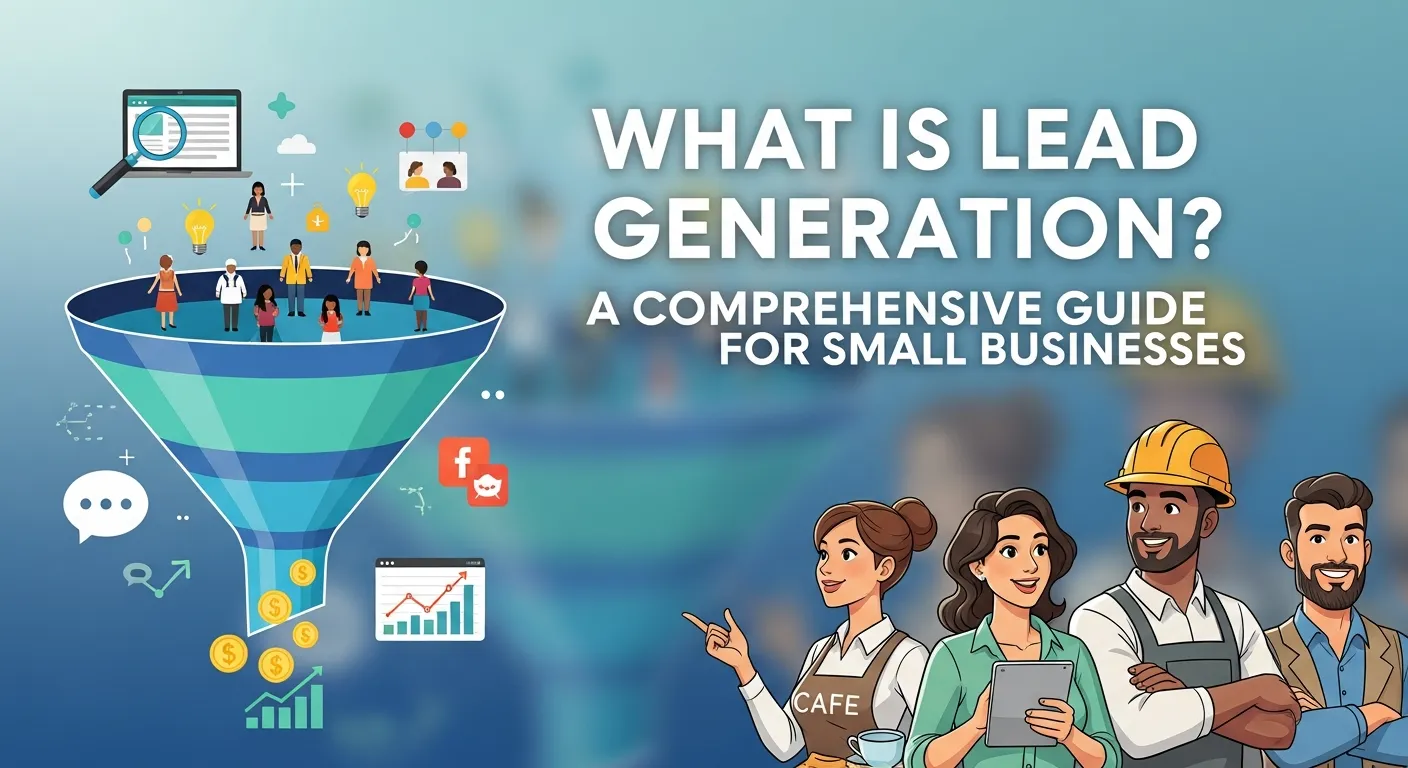
In the competitive modern marketplace, understanding what lead generation is is the definitive bridge between having a great product and actually achieving sustainable, long-term revenue growth for your company.
This guide explores the mechanics of attracting prospects, from identifying your ideal customer profile to leveraging automated lead generation tools. We cover B2B vs. B2C tactics, the role of AI, and how to measure success through essential metrics.
What Is Lead Generation?
At its core, what is lead generation? It is the process of stimulating and capturing interest in a product or service for the purpose of developing a sales pipeline. In the digital age, this isn’t just about cold calling; it’s about creating a holistic ecosystem where potential customers find you, engage with your brand, and raise their hands to say, “I’m interested.”
For a small business, lead generation is the “seeds in fertile soil” analogy. Without a steady stream of leads, your sales team (or you, the owner) will have no one to talk to, leading to stagnant growth. According to SEMrush, lead generation is often the top priority for marketers because it directly impacts the bottom line.
Is Lead Generation Sales or Marketing?
A common point of confusion is whether this process belongs to sales or marketing. The answer is both. Marketing typically handles the “top of the funnel” activities—raising awareness and capturing contact info. Sales takes over the “bottom of the funnel” to close the deal. This synergy is often referred to as “Smarketing.”
The Strategic Framework: How Does Lead Generation Work?
To master what lead generation is, you must understand the journey a stranger takes to become a customer.
- Discovery: A visitor discovers your business through a marketing channel (SEO, social media, or a bandit sign for local marketing).
- Call to Action (CTA): The visitor clicks on a button or link that encourages them to take a specific action.
- Landing Page: This is a web page designed specifically to capture leads in exchange for an offer.
- Lead Magnet: This is the “value” you give away (e.g., an ebook or webinar) in exchange for the lead’s information.
Demand Generation vs. Lead Generation
While related, they aren’t the same. Demand generation is about creating a buzz and brand awareness—getting people to want what you sell. Lead generation is the specific act of collecting their data so you can follow up.
Proven Lead Generation Strategies for 2026
Content Marketing Lead Generation
Content remains king. By producing high-quality blogs and videos, you answer the questions your prospects are asking.
- The Power of Interactive Content: Use interactive content strategies like calculators or assessments to increase engagement.
- Video Marketing for Lead Generation: Videos often have higher conversion rates than text alone, as they build trust through visual storytelling.
Search Engine Optimization (SEO)
What is SEO lead generation? It is the practice of optimizing your website so that it ranks for terms your customers search for. Unlike paid ads, organic lead generation provides a long-term return on investment. Working with an SEO lead generation company can help you identify high-intent keywords that move the needle.
Social Media & Facebook Lead Generation
Social media is no longer just for “likes.” A Facebook lead generation campaign allows you to use “Instant Forms,” where users can submit their info without ever leaving the app.
- How to check your Facebook ad leads effectively: Use the Meta Business Suite or integrate your CRM to ensure no lead goes cold.
- LinkedIn for B2B: For professionals, LinkedIn is the best lead generation platform, specifically for B2B sales leads.
Interactive Tools: Quizzes and Chatbots
Harness the power of interactive quizzes for lead generation to provide personalized results to users while capturing their email. Similarly, leveraging AI chatbots for lead generation allows you to qualify prospects 24/7. An AI-powered lead generation bot can ask qualifying questions and book appointments while you sleep.
Advanced Tactics: Hyper-Personalization and AI
Hyper-Personalized Lead Generation
In 2026, generic emails are ignored. Hyper-personalized lead generation uses data to tailor every touchpoint. This might involve using a prospect’s name, company, and recent industry news in a cold email for a lead generation campaign.
Predictive Lead Generation
Predictive lead generation uses data analytics and AI to identify “high-value prospects” before they even contact you. By analyzing patterns, you can focus your energy on leads most likely to convert.
The Role of Virtual Assistants
Many businesses now use virtual assistants for lead generation to handle the manual labor of prospecting on LinkedIn or managing ping post lead generation systems, where leads are sold in real-time to the highest bidder.
Industry-Specific Lead Generation Strategies
| Industry | Primary Strategy | Key Tool/Tactic |
| Real Estate | Real estate wholesale lead generation | Bandit signs & Hyperlocal SEO |
| B2B Software | A comprehensive guide to B2B lead generation | Whitepapers & LinkedIn Outreach |
| Mortgage | Mortgage broker lead generation strategies | Rate calculators & SEO |
| Manufacturing | Manufacturing lead generation | Trade show follow-ups & SEO |
| Legal | Personal injury lawyers lead generation | Local Service Ads (LSAs) |
| Nonprofit | Nonprofit lead generation strategies | Storytelling & Donation landing pages |
Essential Lead Generation Tools
To avoid being overwhelmed, you need the right tech stack.
- CRM for Lead Management: Tools like HubSpot or Salesforce are essential for tracking the B2B lead generation process.
- Lead Generator Software: Tools like FatRank or OptinMonster help capture intent.
- Automated Lead Generation Tools: Use Zapier or Make to connect your forms to your email marketing software.
- Google My Business: For local companies, Google My Business for lead generation is indispensable for appearing in the “Map Pack.”
Measuring Success: Essential Lead Generation Metrics
You can’t improve what you don’t measure. Focus on these KPIs:
- Conversion Rate: How many visitors become leads?
- What is Cost Per Lead (CPL)? Divide your total spend by the number of leads generated.
- Lead Quality: Use a lead scoring system to qualify leads effectively.
- ROI: The ultimate measure of whether your lead generation company’s pricing is worth it.
Should You Outsource Lead Generation?
Many small business owners ask, “Should you outsource lead generation?”
- Pros: Access to experts, faster scaling, and better tools.
- Cons: Higher upfront cost and less control over the brand voice.
- If you are a startup, you might want to master lead generation for startups internally first before hiring the best lead generation agency.
Addressing Unique Questions

- Low-Lead Gasoline in Generators? While unrelated to marketing, it’s a common search query. No, always use the fuel recommended by the manufacturer to avoid engine damage!
- Photosynthesis Hacks for Growth? Just as plants need light, your business needs leads. Think of your SEO as the sun and your CRM as the water.
- Lead Generation in Banking: This involves highly regulated data collection focused on trust and security.
Lead Generation vs. Prospecting: Understanding the Nuance
While often used interchangeably, there is a distinct difference between lead generation and prospecting. Lead generation is typically an inbound, “one-to-many” approach where marketing creates content to pull people in. Lead generation vs. prospecting shifts when sales reps take a “one-to-one” approach, actively reaching out to specific individuals (outbound) who fit the ICP. For a small business, a healthy mix of both ensures you aren’t just waiting for the phone to ring.
Real Estate Wholesale Lead Generation: Finding Hidden Gems
In the property market, undeniable real estate wholesale lead generation tactics for finding high-quality leads often involve “driving for dollars” or looking for distressed properties. Successful investors use real estate wholesale lead generation to find motivated sellers before they list on the MLS. This niche requires a blend of digital tracking and physical marketing, such as the ultimate guide to bandit signs for local marketing and lead generation success, which remains a staple for local visibility.
The Technical Side: WordPress Lead Generation and Security
If your website is the engine, your CMS is the fuel. WordPress lead generation is popular because of the vast array of plugins available to capture data. However, as you grow, you must consider security. For example, what makes Sophos a cybersecurity leader in next-generation tech? Protecting your lead data is as important as collecting it. If your site is hacked and lead data is leaked, your reputation—and your business growth—will stall.
Lead Generation in Recruitment and BPO Industry
What is lead generation in recruitment? In the HR world, it’s about finding “passive candidates”—people who aren’t looking for a job but are open to the right offer. Similarly, what process is lead generation in the BPO industry? Business Process Outsourcing firms often handle the “grunt work” of lead gen, such as cold calling or data entry, allowing your internal team to focus on closing deals. This is often part of outsource lead generation services that help companies scale without increasing headcount.
Hyperlocal Lead Generation: Dominating Your Neighborhood
For service-based businesses like plumbers or lawyers, hyperlocal lead generation is the key to ROI. Instead of targeting a whole state, you target specific zip codes. A great way to do this is to generate new customer leads in Orlando with Google Local Service Ads (or your specific city). By appearing at the very top of Google for local searches, you capture high-intent leads exactly when they need you.
Mastering Omnichannel Lead Generation
Gone are the days of relying on just one platform. Mastering omnichannel lead generation means your brand follows the prospect from an Instagram ad to a Google search, and finally to an email follow-up. Using a CRM for lead management ensures that no matter where the lead comes from—a lead generation bot or a manual trade show entry—their journey is documented and personalized.
The Role of “Ping Post” Lead Generation

In high-volume industries like insurance or home improvement, ping post lead generation is a common technical process. The “ping” sends partial data to a network of buyers to see who wants it, and the “post” sends the full lead details to the winner. This ensures leads are sold and contacted in seconds, maximizing the chance of conversion.
Niche Considerations: From Solar to Home Depot
Specific industries have unique models. For instance, knowing how to generate solar leads and grow your business involves educational marketing about energy savings. On the retail side, have you ever wondered what a lead generator does at Home Depot? These are individuals who engage shoppers in-store to set up consultations for home services, proving that “offline” lead generation is still alive and well.
Is There Any Legitimacy to Lead-Generating Websites?
Many owners wonder, is there any legitimacy to lead-generating websites? Platforms like Angi or Thumbtack can provide a quick boost, but they often sell the same lead to five competitors. While they are among the best lead generation sites for quick volume, building your own organic lead generation assets (like a blog) is usually more profitable in the long run.
Fun Funnel Facts: From Low-Lead Gas to Photosynthesis
To add some personality to your guide, consider how “growth” is universal. Just as photosynthesis hacks optimize how plants turn light into energy, lead generation optimizes how you turn traffic into revenue. And just as you might ask, “Low-lead gasoline: can you safely use it in generators?” (The answer is: check your manual, as it can damage modern engines!), you must ensure you are using the right “fuel” for your marketing. Using outdated tactics is like putting the wrong gas in a high-performance generator—it might run for a bit, but eventually, it will break.
Zero-Party Data: The Privacy-First Gold Mine
As third-party cookies vanish, the future of what leads generation lies in zero-party data. This is information that customers intentionally and proactively share with you.
- The Opportunity: Instead of “spying” on behavior, you invite it. By using preference centers and interactive assessments, you ask users about their challenges directly.
- Implementation: Create “Choice-Based Funnels” where users select their industry or pain point upon entering your site. This allows for hyper-personalized lead generation that builds trust rather than suspicion.
- Immersive Lead Gen: VR and AR Experiences
Virtual Reality (VR) and Augmented Reality (AR) are no longer just for gaming. They are becoming powerful lead capture tools for high-ticket items.
- Virtual Showrooms: A small furniture business can allow a lead to “place” a sofa in their living room via AR. To unlock the full 3D model, the user provides their email.
- The Strategy: This provides a “tangible” experience before a purchase, significantly qualifying the lead. It turns a static website into an interactive lead generation playground.
Voice and Conversational Search Optimization
In 2026, voice search is a dominant input. What is lead generation in the age of Alexa and Siri? It is about becoming the “Featured Snippet” that an AI reads aloud.
- Conversational Queries: People don’t type “best CRM.” They ask, “What is the best CRM for a small marketing agency in Orlando?”
- Actionable Step: Optimize your content for long-tail, question-based keywords. Adding an FAQ section designed for voice search optimization ensures your business is the one recommended by smart assistants.
Predictive Analytics and Quantum AI
We are entering the era of “predictive” rather than “reactive” marketing. Predictive lead generation uses AI to analyze massive datasets—sometimes powered by emerging hybrid quantum models—to identify a prospect’s “intent to buy” before they even search for a solution.
-
Future-Proofing: Small businesses can use tools that monitor “intent signals” across the web. If a prospect is reading articles about “how to scale a manufacturing plant,” your manufacturing lead generation system can trigger a targeted LinkedIn ad to them immediately.
Community-Led Growth (CLG)
The future of what is lead generation is moving away from rented platforms (like Facebook) and toward owned communities.
- Niche Communities: By hosting a private Slack channel, Discord, or a specialized forum, you become a “market of one.”
- The Benefit: These leads are pre-warmed and have a much higher lead quality because they have already engaged with your brand’s culture. This is the ultimate form of organic lead generation, where your existing members actually help generate new leads through word-of-mouth.
Conclusion
Understanding what lead generation is is the first step toward transforming your small business into a high-growth engine. By combining content marketing, SEO, and AI chatbots, you create a resilient system that attracts high-quality prospects consistently. Start small, test your strategies, and watch your business thrive through the power of sustainable lead generation.
FAQs
1. What is lead generation in simple terms?
Lead generation is the process of attracting people who may be interested in your product or service and collecting their contact information. It helps turn website visitors or social media users into potential customers so businesses can start meaningful conversations and guide them toward a purchase decision.
2. What is the difference between a lead and a prospect?
A lead is someone who has shown interest in your business and shared basic contact details. A prospect is a more refined version of a lead—someone who fits your ideal customer profile, has a genuine need, and shows buying intent, making them more likely to convert.
3. Is lead generation better than cold calling?
In most modern business environments, lead generation performs better than cold calling. Lead generation focuses on attracting people who are already interested in a solution, while cold calling interrupts people who may not be ready or willing to engage. As a result, inbound leads tend to convert at higher rates and help build trust more effectively.
4. How much does lead generation cost?
The cost of lead generation varies depending on industry, competition, and marketing channels. In lower-competition niches, the cost per lead can be relatively affordable, while high-competition sectors such as legal services, finance, or software often require significantly higher investment due to bidding wars and buyer demand.
5. Can I do lead generation on a zero budget?
Yes, lead generation can be done without a paid budget by focusing on organic strategies. These include search engine optimization, consistent social media engagement, content creation, referrals, and direct networking. While free, these methods require time, patience, and consistent value delivery.
6. What is a lead magnet?
A lead magnet is a free resource offered in exchange for contact information. It is designed to solve a specific problem or provide immediate value, such as an e-book, checklist, template, free trial, or email course. A well-designed lead magnet attracts high-quality leads rather than just high volume.
7. How do I generate leads on LinkedIn?
Lead generation on LinkedIn works best when you focus on sharing valuable insights, optimizing your profile for your target audience, and engaging in meaningful conversations. Using advanced search tools and personalized outreach helps build relationships that convert into qualified leads over time.
8. What is the B2B lead generation process?
The B2B lead generation process focuses on identifying businesses that need your solution and reaching decision-makers within those organizations. Because B2B sales cycles are longer, the process emphasizes trust-building, education, and consistent follow-up before a buying decision is made.
9. Why is lead generation the lifeblood of business growth?
Lead generation keeps the sales pipeline active. Without a steady flow of leads, businesses struggle to generate revenue, forecast growth, or scale operations. Consistent lead generation creates predictability, stability, and long-term sustainability.
10. What is an AI lead generation bot?
An AI lead generation bot is an automated system that uses artificial intelligence to engage website visitors in real time. It answers common questions, qualifies visitors based on their responses, and collects contact information automatically, allowing businesses to generate leads around the clock without manual intervention.



Leave a Reply